Does Hypnotherapy Work? What the Research Actually Says
Apr 14, 2026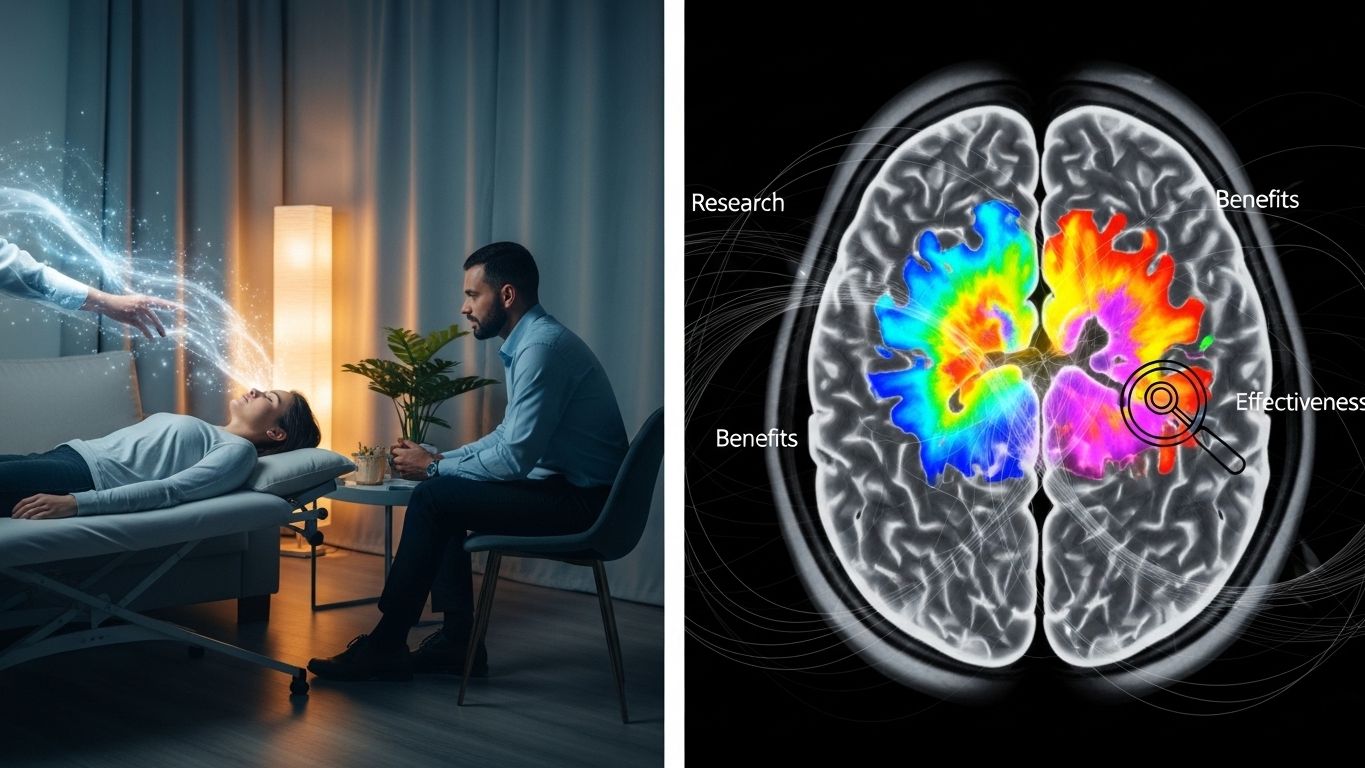
You've probably pictured it: a swinging pocket watch, dramatic music, someone clucking like a chicken on command. That's stage hypnosis – entertainment with almost nothing in common with what happens in a clinical setting. But the image sticks, and it's one of the main reasons so many people quietly wonder: does hypnotherapy work for anything beyond entertainment?
The short answer is yes, but for certain conditions, under the right circumstances, and with a qualified practitioner.
Here's what the research actually says.
Key Takeaways:
- Hypnotherapy is a clinically recognised therapeutic tool, approved by the American Medical Association and documented in peer-reviewed literature as effective for pain management, anxiety, and IBS.
- Brain imaging studies confirm that hypnosis produces measurable changes in neural activity – it's not a placebo in the traditional sense.
- For smoking cessation, around two-thirds of peer-reviewed studies report positive outcomes; some trials show comparable results to CBT.
- Not everyone is equally hypnotisable. Results vary significantly between individuals.
- Stage hypnosis and clinical hypnotherapy are entirely different things – a trained, qualified hypnotherapist is essential in seeing results
What is Hypnotherapy, and How Does Hypnotherapy Work?
Hypnotherapy uses guided relaxation, focused attention, and verbal suggestion to bring a person into a trance-like state. Not sleep – that's one of the biggest misconceptions.
Hypnosis creates a hyper-attentive and hyper-responsive mental state in which the subconscious mind is more open to suggestion. Good hypnotic subjects are active problem solvers. Free will and moral judgment are not switched off.
You can't be hypnotised into doing things against your will or forced into a hypnotic state.
So, how does hypnotherapy work at a neurological level?
Brain imaging research – including fMRI and EEG studies – shows that hypnosis produces functional changes in neural activity. When a suggestion is made that certain sensations don't bother you, the part of the brain that processes how upset you are by pain decreases in activity. But the part of the brain that processes intensity of sensation doesn't necessarily change.
Hypnosis isn't blocking the pain signal itself, but changing how distressing you find it. Hypnosis has proven to be a powerful method in pain control and anxiety reduction.
There are two main clinical approaches. Suggestion therapy uses the hypnotic state to help someone change behaviour or perception, which is useful for habits, phobias, and pain. Analytical hypnotherapy (sometimes called hypnoanalysis) uses the relaxed state to explore psychological root causes of a problem, often in combination with traditional psychotherapy.
Does Hypnotherapy Work? The Evidence by Condition
The research base has grown substantially over the past two decades. A bibliometric analysis examining 1,549 publications on clinical hypnotherapy found a steady average annual growth rate of 8.5% – over twice the overall growth rate of scientific publications. After 2021, annual publications have surpassed 100.
Chronic pain
Hypnotic interventions for chronic pain result in significant reductions in perceived pain that, in some cases, may be maintained for several months. In a few studies, hypnotic treatment was found to be more effective, on average, than some other treatments such as physical therapy or education. One controlled study of fibromyalgia patients found the hypnosis group showed significantly better outcomes than the physical therapy group on measures of muscle pain, fatigue, sleep disturbance, and patient-assessed wellbeing. These differences were also maintained at the 3-month follow-up.
Anxiety
A systematic review published in PMC found that medical hypnosis had a significant impact on reducing anxiety symptoms, including emotional stress, pain, and medication use in patients undergoing medical procedures.
IBS
Gut-directed hypnotherapy has a particularly well-documented evidence base, with multiple randomised controlled trials showing meaningful symptom reduction for patients who hadn't responded well to other interventions.
The research does present certain limitations. Many studies use small sample sizes, variable induction techniques, and self-report measures. A comprehensive evaluation of hypnosis published in the NIH's National Library of Medicine reports medium efficacy for ICD-10 psychological disorders, and acknowledges that outcomes are lower for some applications. The overall picture is genuinely mixed – which is worth acknowledging, because overselling it does the field no favours.
Does Hypnotherapy Work for Smoking?
This is probably the most common reason people look into hypnotherapy in Australia. And the research, while not definitive, is more positive than sceptics would have you believe.
A systematic review of 33 studies found that 66.7% reported a positive impact of hypnosis interventions for smoking cessation. Positive impact studies tended to have longer average treatment duration and a greater number of hypnotherapy sessions. Expectations around one-and-done sessions aren’t realistic, since duration is a significant variable.
An RCT published in Complementary Therapies in Medicine found that hypnotherapy outperformed nicotine replacement therapy in patients hospitalised for a smoking-related cardiac or pulmonary illness. This finding is particularly relevant given that this is exactly the population with the most urgent need to quit.
A 2024 RCT comparing hypnotherapy directly with cognitive behavioural therapy found that continuous abstinence rates were comparable between the two: 15.0% for the hypnotherapy group versus 15.6% for CBT at 12-month follow-up. That's not a revolution, but it's meaningful parity with one of the most established behavioural interventions in the field.
The honest summary: does hypnotherapy work for smoking? For many people, yes, particularly when delivered as part of a multi-session programme with a qualified practitioner and combined with genuine motivation to quit.
Does Hypnotherapy Work for Alcoholism?
Research in this area is thinner, but growing. Only two randomised controlled trials on hypnotherapy for alcohol use disorder (AUD) have been conducted, which limits the clarity of an answer.
However, hypnotherapy has been applied to alcoholism for over a century and is accepted by the AMA as a medically valid technique, though the effectiveness of hypnosis in treating alcoholics remains inconclusive.
The most rigorous recent trial, an RCT conducted at an inpatient clinic in Norway, found that patients receiving hypnotherapy marginally outperformed those receiving motivational interviewing at a one-year follow-up, with a higher proportion reporting total abstinence in the hypnotherapy group – though the result didn't reach statistical significance.
One PubMed-indexed study using intensive daily hypnotherapy sessions (20 sessions) for substance use disorders reported a 77% success rate for at least a one-year follow-up period, though that's a small study of 18 clients rather than a large RCT.
People with alcoholism may benefit from a combination of hypnotherapy and other forms of counselling, but more scientific research is needed. Hypnosis isn't magic – it can't cure alcoholism on its own, but it can make a useful addition to a treatment plan for alcohol use disorders.
Hypnotherapy is a complement rather than a cure, it's a meaningful tool when embedded within broader clinical care.
Who is Hypnotherapy Most Likely to Work For?
Not everyone responds equally to hypnosis. While it appears that almost anyone can be hypnotised, hypnosis does not always bring about good results. Some researchers believe that the ability to be hypnotised is a learned skill, while others believe a person is born with certain traits that allow hypnosis to work. The ability to focus, a willingness to engage, and openness to the process all matter.
High hypnotisability is associated with stronger outcomes, and notably, it's not correlated with suggestibility in the everyday sense of being easily influenced. A strong-minded person who can concentrate deeply may actually be an excellent candidate.
Hypnotherapy is not appropriate as a standalone treatment for major psychiatric disorders such as schizophrenia, bipolar disorder, or severe depression. It's also contraindicated for chronic pain that hasn't been medically investigated, and should always be discussed with your GP before beginning, particularly if you're currently receiving other treatment.
Thinking About Training in Hypnotherapy?
If you've been exploring this space and wondering about a deeper involvement, whether to use hypnotherapy professionally or to deliver better results in your own practice, training matters enormously. The difference between a well-trained clinical hypnotherapist and someone with a weekend certificate is not subtle.
The Australian Academy of Hypnosis offers fully in-person hypnotherapy courses with recognised qualifications, small-group environments, real-session experience, and ongoing mentorship. You're not watching videos in isolation. Instead, you're learning in a room, with guidance, with immediate application.
Check the current course dates or enrol directly today.
Common Misconceptions Worth Clearing Up
"You lose consciousness."
You don't. Most people remember everything. It's a common myth that you lose consciousness or go to sleep when under hypnosis. Most people remember everything that happens during a session. In fact, hypnosis can be a very active process.
"The hypnotherapist controls your mind."
They don't. Hypnosis is not mind control or brainwashing. A therapist cannot make a person do something embarrassing or that the person doesn't want to do.
"It's instant."
Rarely. Hypnotherapy tends to be a process of several sessions, working through unconscious blocks and choosing to allow new beliefs. The research on smoking, pain, and anxiety consistently shows better outcomes with multiple sessions.
"If it works, it's just a placebo."
This doesn't hold up against the neuroimaging evidence. Brain scans taken during hypnotic states show measurable, reproducible changes in neural activity. That's not a placebo response, that's physiology.
Does Hypnotherapy Work?
Yes, but the question is probably better framed as for what, for whom, and under what conditions.
The evidence for pain management and anxiety is solid. The evidence for smoking cessation is promising, particularly across multiple sessions. The evidence for alcohol use disorder is early but encouraging. And the neurological basis is now documented well enough that dismissing it as pseudoscience doesn't hold up.
What it isn't: a guaranteed cure, a replacement for medical care, or something that works identically for every person. Like any clinical intervention, the quality of the practitioner and the commitment of the client both shape the outcome.
Ready to Turn Evidence Into Real Skill?
Hypnotherapy isn’t just theory – it’s a practical, evidence-backed skill that changes how people think, feel, and respond. But results depend on one thing: the quality of the practitioner.
At the Australian Academy of Hypnosis, you don’t just learn about hypnosis, you practise it, refine it, and build real confidence through hands-on, in-person training.
Learn how to apply what the research proves with real clients, real guidance, and real results. Enrol in one of our courses today.